A composer viewing this century's music. [UCSD Lecture III]
Abstract
Im Jänner und Februar 1970 war Ernst Krenek Regent’s Lecturer an der University of California, San Diego, wo er eine Serie von vier Vorträgen hielt unter dem übergeordneten Titel: „A Composer Viewing This Century’s Music“. Die Vorträge wurden jeweils Mittwoch abends gehalten und waren einer weit gespannten Themenpallette gewidmet.
Ernst Kreneks dritter Vortrag als Regent’s Lecturer an der UCSD, gehalten am 4. Februar 1970. In der ersten Hälfte des Vortrags setzt sich Krenek mit der Beziehung von Komponierenden und der Gesellschaft auseinander, und welche stilistischen Entwicklungen sich aus dieser Beziehung im Lauf der Musikgeschichte ergaben. Die zweite Hälfte ist vor allem ökonomischen Fragen und Problemen der Komponierenden im 20. Jahrhundert gewidmet.
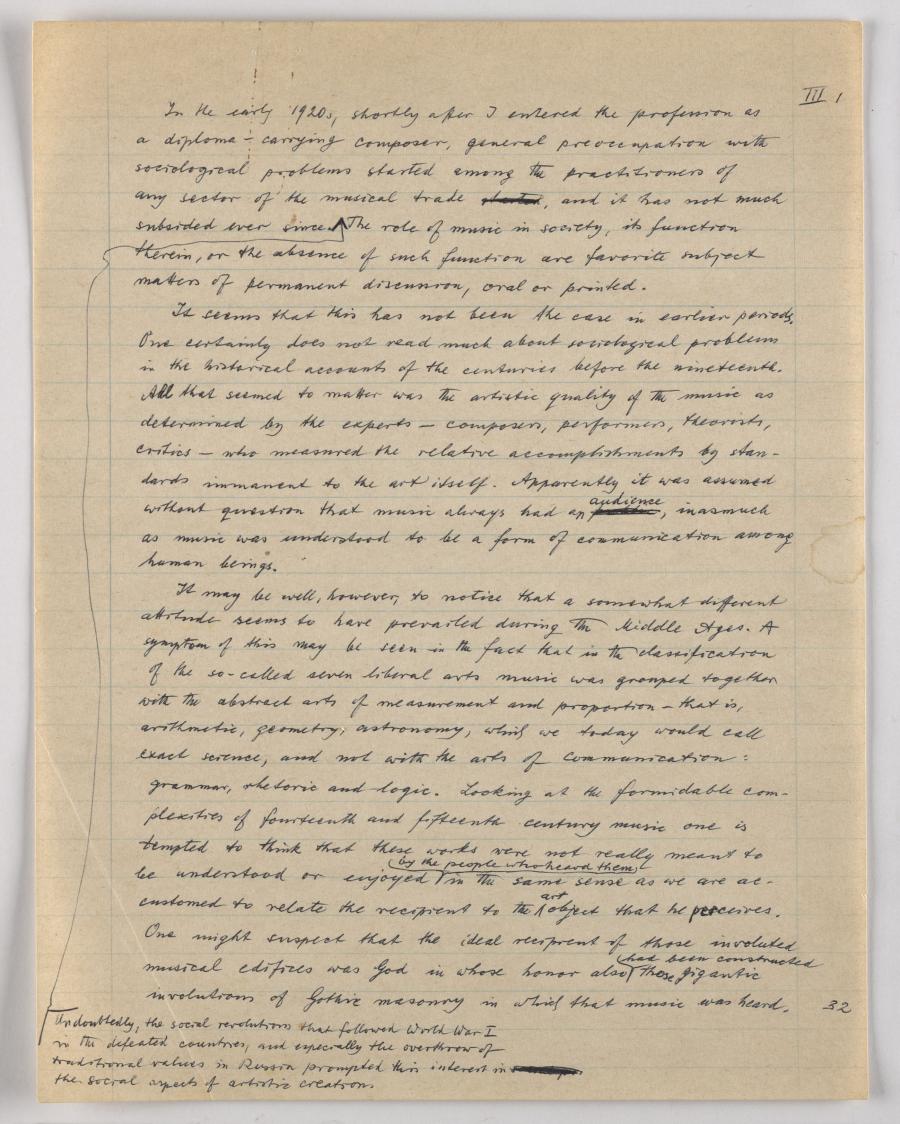
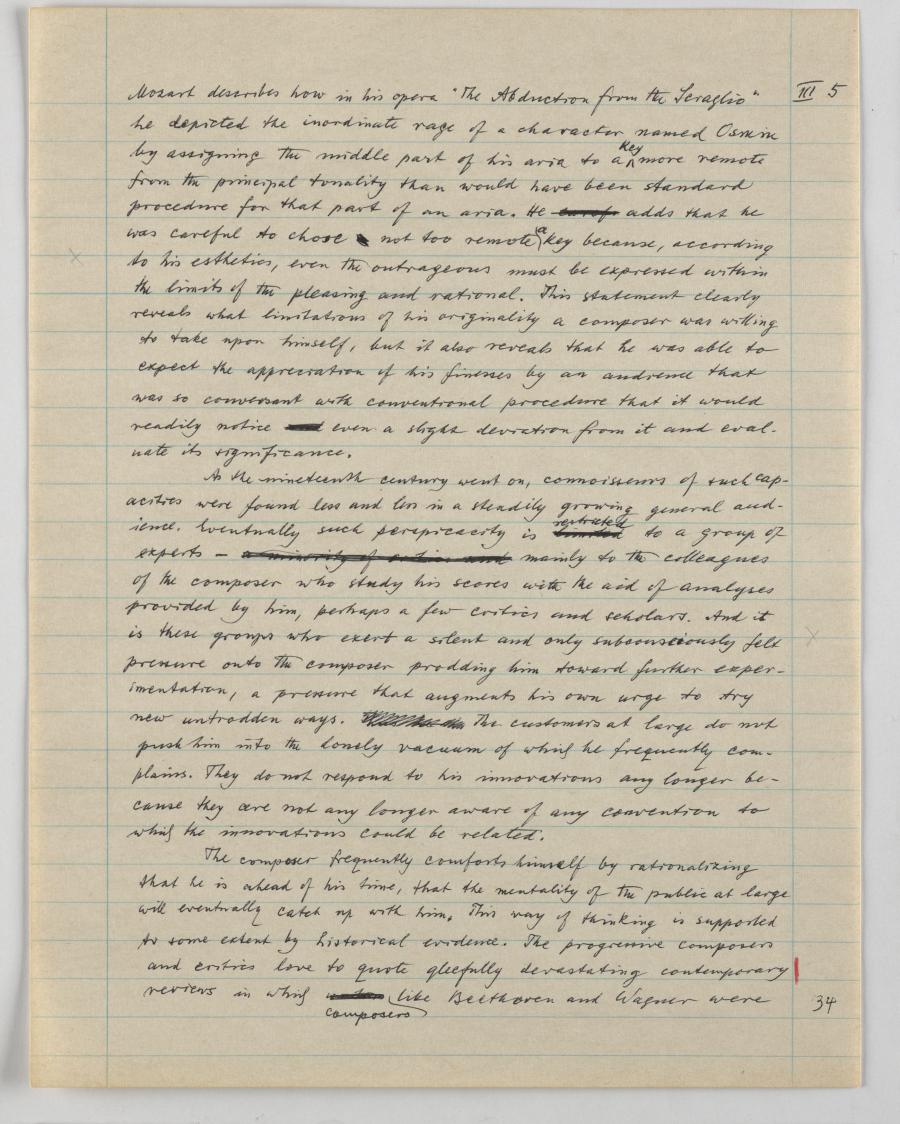
In the early 1920s, shortly after I entered the profession as
a diploma-carrying composer, general preoccupation with
sociological problems started among the practitioners of
any sector of the musical trade
It seems that this has not been the case in earlier periods.
One certaily does not read much about sociological problem
in the historical accounts of the centuries before the nineteenth.
All that seemed to matter was the artistic quality of the music as
determined by the experts - composers, performers, theorists,
critics - who measured the relative accomplishments by stan-
dards immanent to the art itself. Apparently it was assumed
without question that music always public
It may be well, however, to notice that a somewhat different
attitude seems to have prevailed during the Middle Ages. A
symptom of this may be seen in the fact that in the classification
of the so-called seven liberal arts music was grouped together
with the abstract arts of measurement and proportion - that is,
arithmetic, geometry, astronomy, which we today would call
exact science, and not with the arts of communication:
grammar, rhetoric and logic. Looking at the formidable com-
plexities of fourteenth and fifteenth century music one is
tempted to think that these works were not really meant to
be understood or
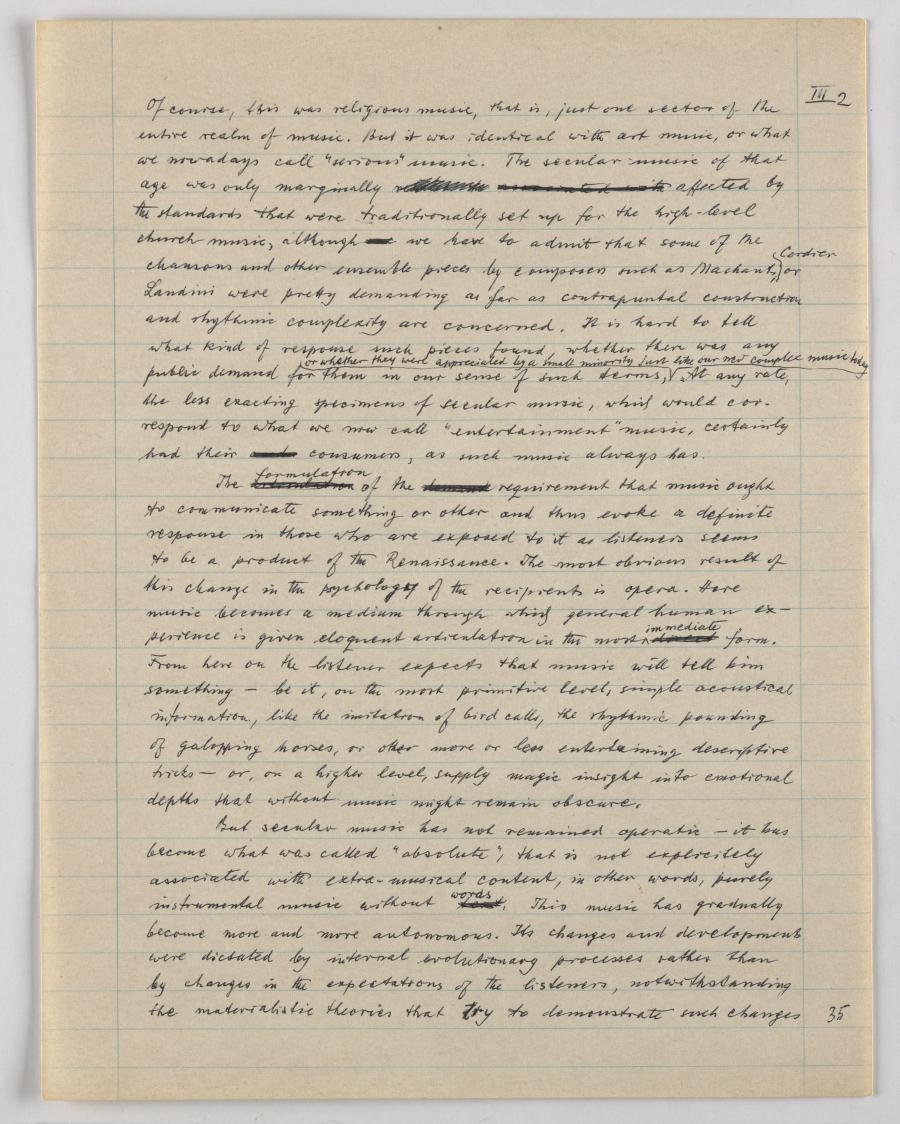
Of course, this was religious music, that is, just one sector of the
entire realm of music. But it was identical with art music, or what
we nowadays call "serious" music. The secular music of that
age was only marginally
articulation demanddirect form.
But secular music has not remained operatic - it has
become what was called "absolute", that is not explicitely
associated with extra-musical content, in other words, purely
instrumental music text
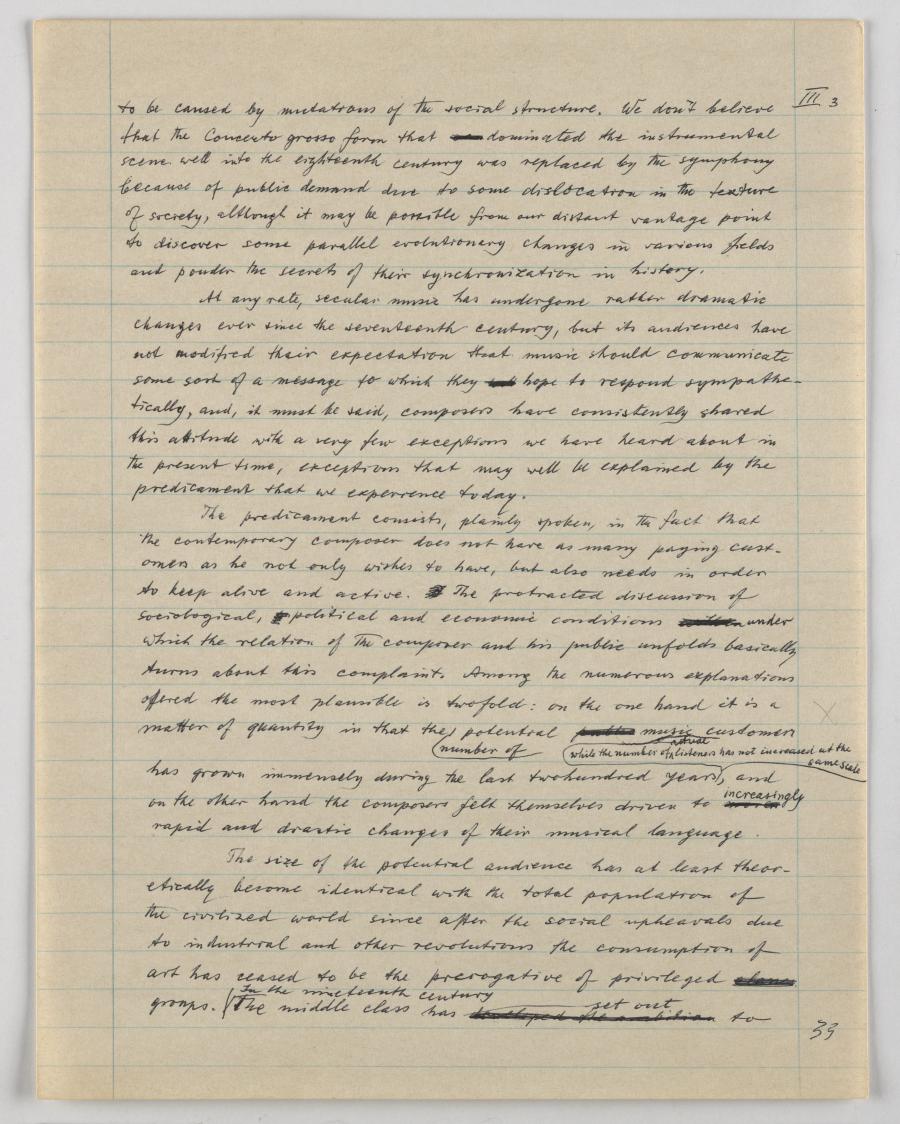
to be caused by mutations of the social structure. We don't believe
that the Concerto grosso form that
At any rate, secular music has undergone rather dramatic
changes ever since the seventeenth century, but its audiences have
not modified their expectation that music should communicate
some sort of a message to which they
The predicament consists, plainly spoken, in the fact that
the contemporary composer does not have as many paying cust-
omers as he not only wishes to have, but also needs in order
to keep alive and active. public musicmore
The size of the potential audience has at least theor-
etically become identical with the total population of
the civilized world since after the social upheavals due
to industrial and other revolutions the consumption of
art has ceased to be the prerogative of privileged developed the ambition to
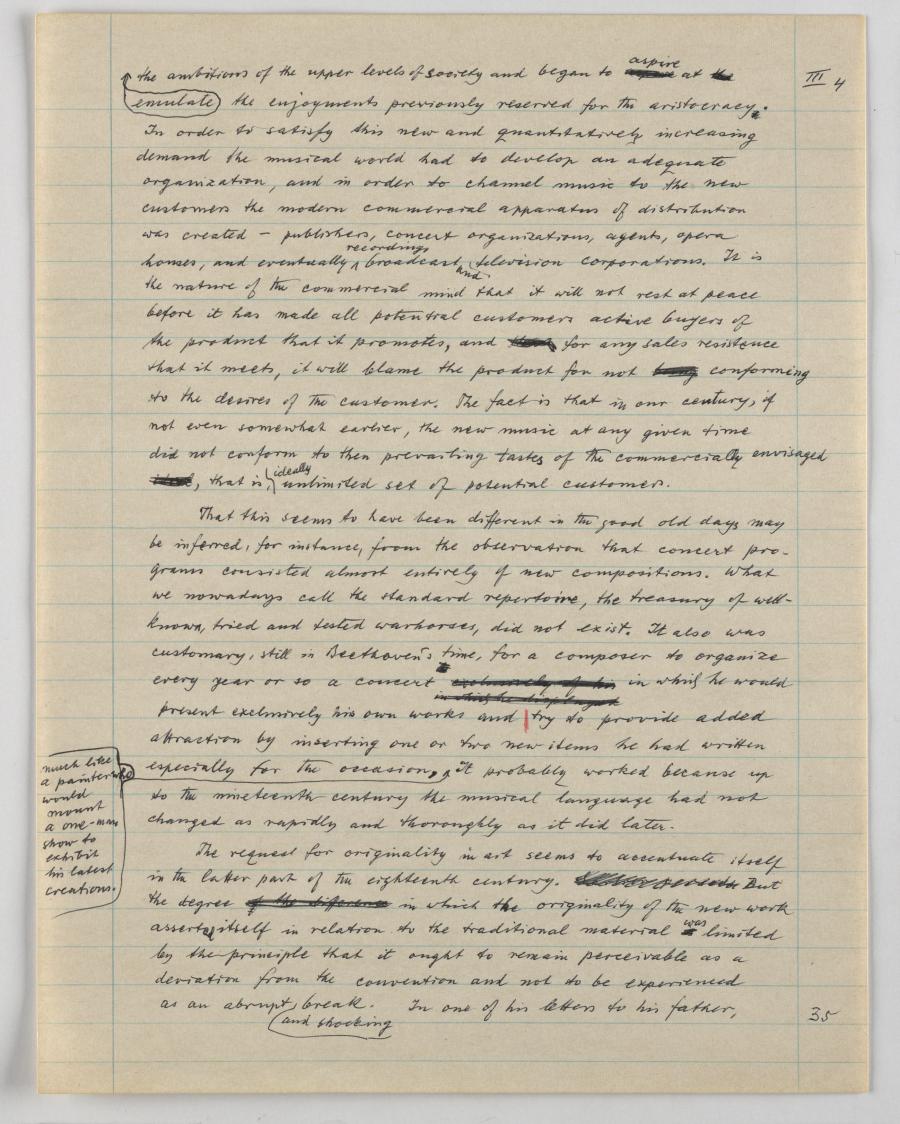
aspire the,.ideal, that is,
That this seems to have been different in the good old days may
be inferred, for instance, from the observation that concert pro-
grams consisted almost entirely of new compositions. What
we nowadays call the standard repertoire, the treasury of well-
known, tried and tested warhorses, did not exist. It also was
customary, still in exclusively of his in which he displays
The request for originality in art seems to accentuate itself
in the latter part of the eighteenth century. is
As the nineteenth century went on, connoisseurs of such cap-
acities were found less and less in a steadily growing general aud-
ience. Eventually such perspicacity limited
The composer frequently comforts himself by rationalizing
that he is ahead of his time, that the mentality of the public at large
will eventually catch up with him. This way of thinking is supported
to some extent by historical evidence. The progressive composers
and critics love to quote gleefully devastating contemporary
reviews in writers
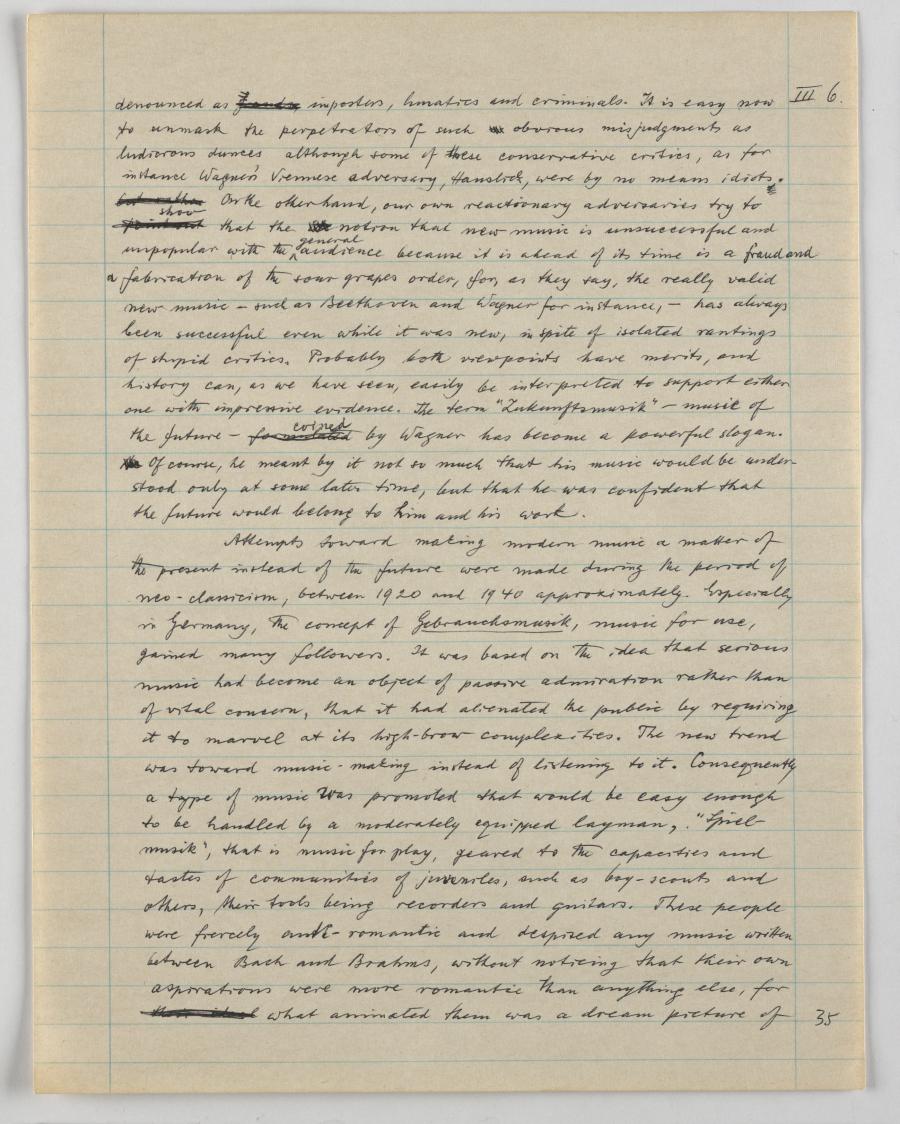
denounced as point out formulated
Attempts toward making modern music a matter of
the present instead of the future were made during the period of
neo-classicism, between 1920 and 1940 approximately. Especially
in Gebrauchsmusik, music for use,
gained many followers. It was based on the idea that serious
music had become an object of passive admiration rather than
of vital concern, that it had alienated the public by requiring
it to marvel at its high-brow complexities. The new trend
was toward music-making instead of listening to it. Consequently
a type of music was promoted that would be easy enough
to be handled by a moderately equipped layman, "Spiel-
musik", that is music for play, geared to the capacities and
tastes of communities of juveniles, such as boy-scouts and
others, their tools being recorders and guitars. These people
were fiercely anti-romantic and despised any music written
between
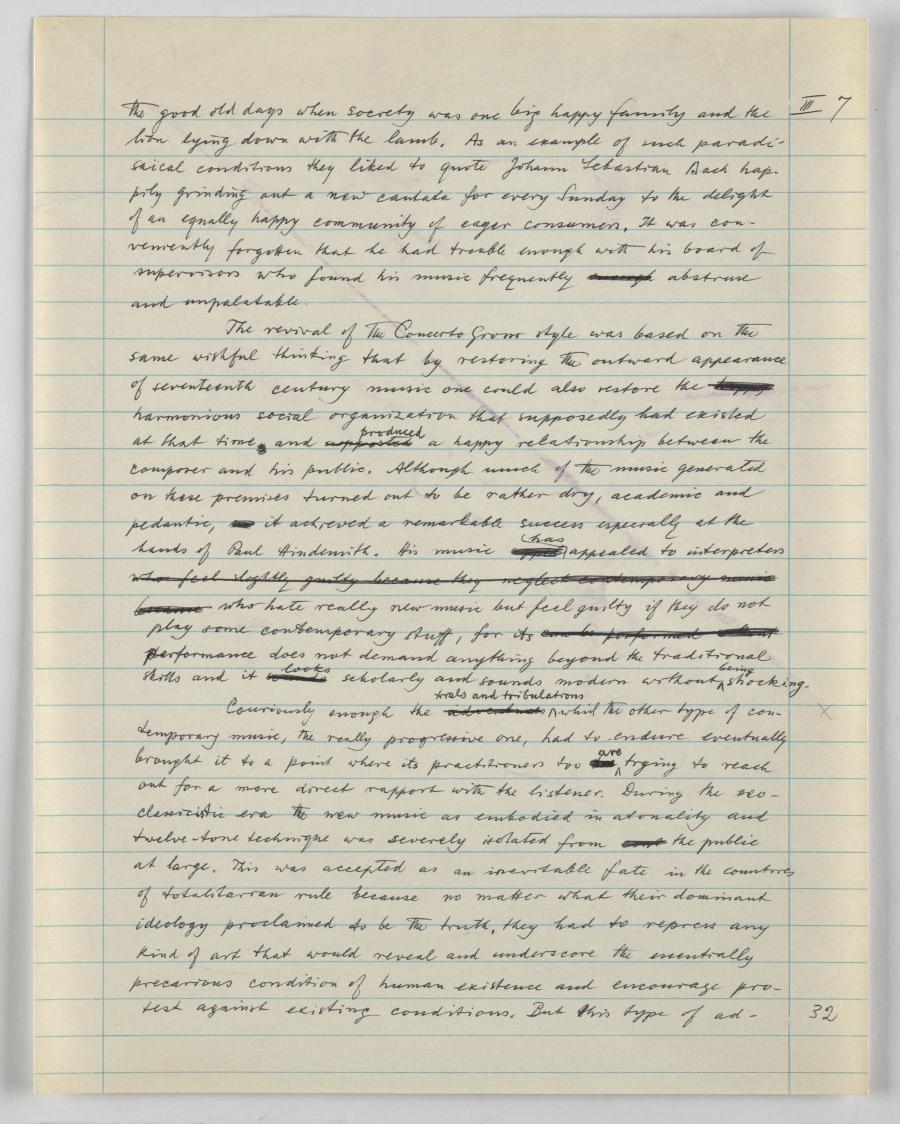
the good old days when society was one big happy family and the
lion lying down with the lamb. As an example of such paradi-
saical conditions they liked to quote
The revival of the Concerto Grosso style was based on the
same wishful thinking that by restoring the outward appearance
of seventeenth century music one could also restore the supported appel sounds
Couriously enough adventures
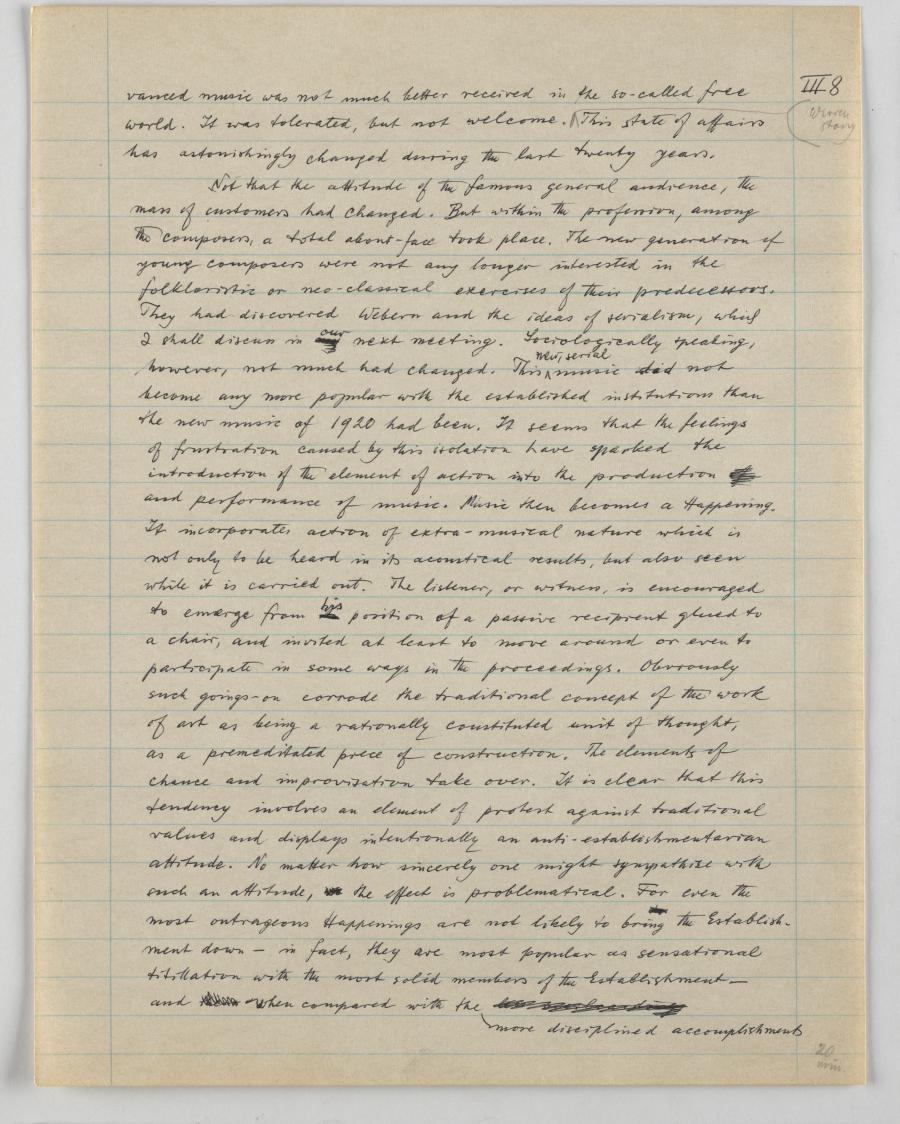
vanced music was not much better received in the so-called free
world. It was tolerated, but not welcome.
Not that the attitude of the famous general audience, the
mass of customers had changed. But within the profession, among
the composers, a total about-face took place. The new generation of
young composers were not any longer interested in the
folkloristic or neo-classical exercises of their predecessors.
They had discovered my its less overboarding
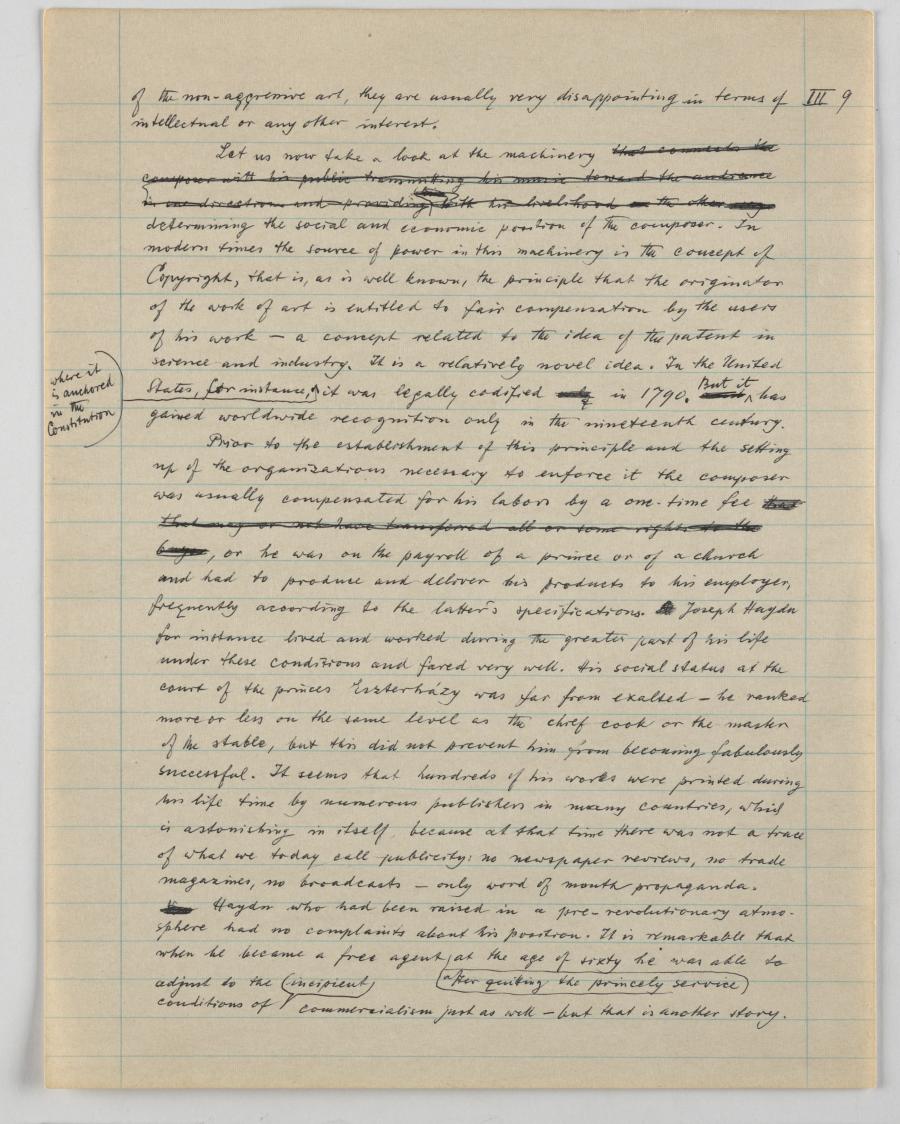
of the non-aggressive art, they are usually very disappointing in terms of intellectual or any other interest.
Let us now take a look at the machinery only in 1790. and
Prior to the establishment of this principle and the setting
up of the organisations necessary to enforce it the composer
was usually compensated for his labors by a one-time fee
But It was also Again One
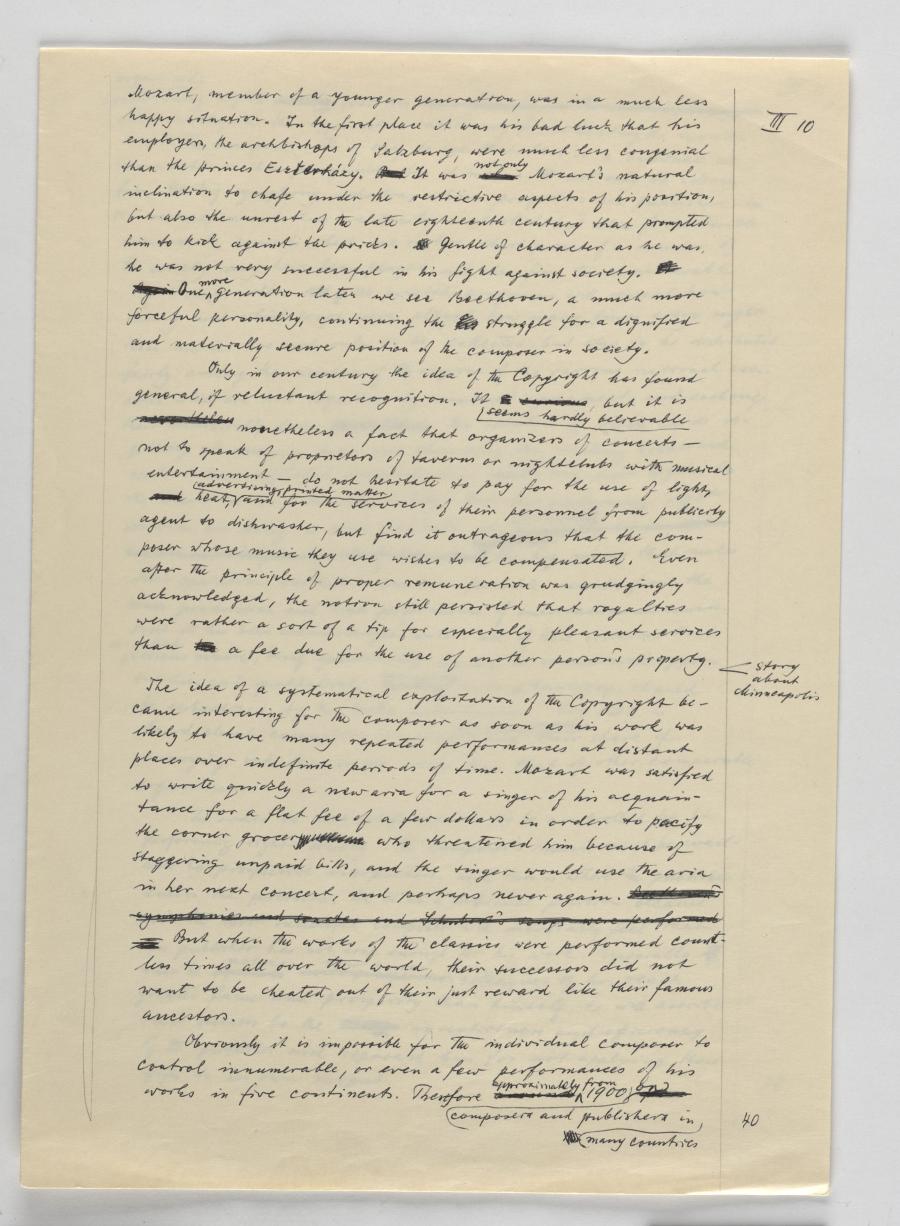
Only in our century the idea of the Copyright has found
general, if reluctant recognition. is curious,and heat, y store
Obviously it is impossible for the individual composer to
control innumerable, or even a few performances of his
works in five continents. arround
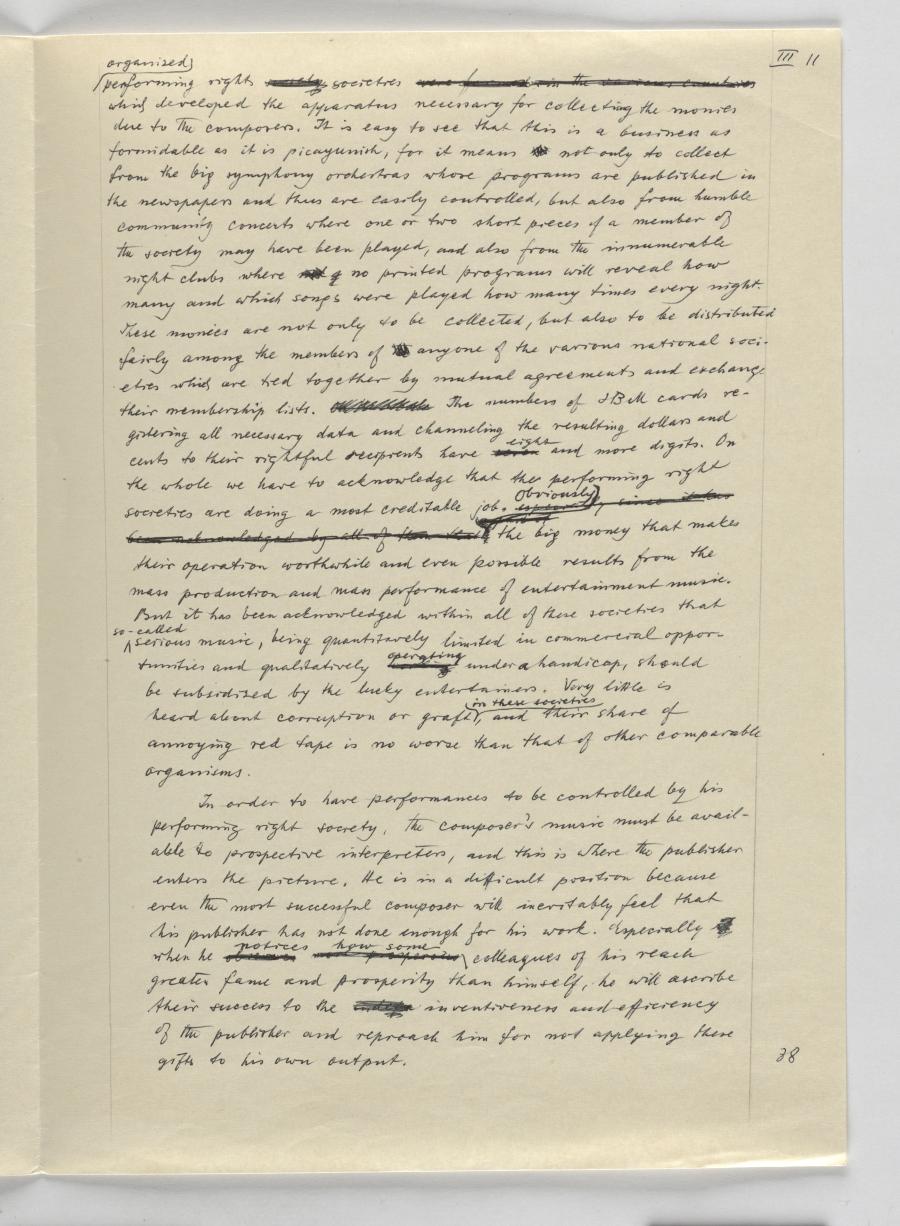
society societies were formed in the various countriesseven been acknowledged by all of them that working
In order to have performances to be controlled by his
performing right society, the composer's music must be avail-
able to prospective interpreters, and this is where the publishers
enters the picture. He is in a difficult position because
even the most successful composer will inevitably feel that
his publisher has not done enough for his work. Especially observes more prosperous
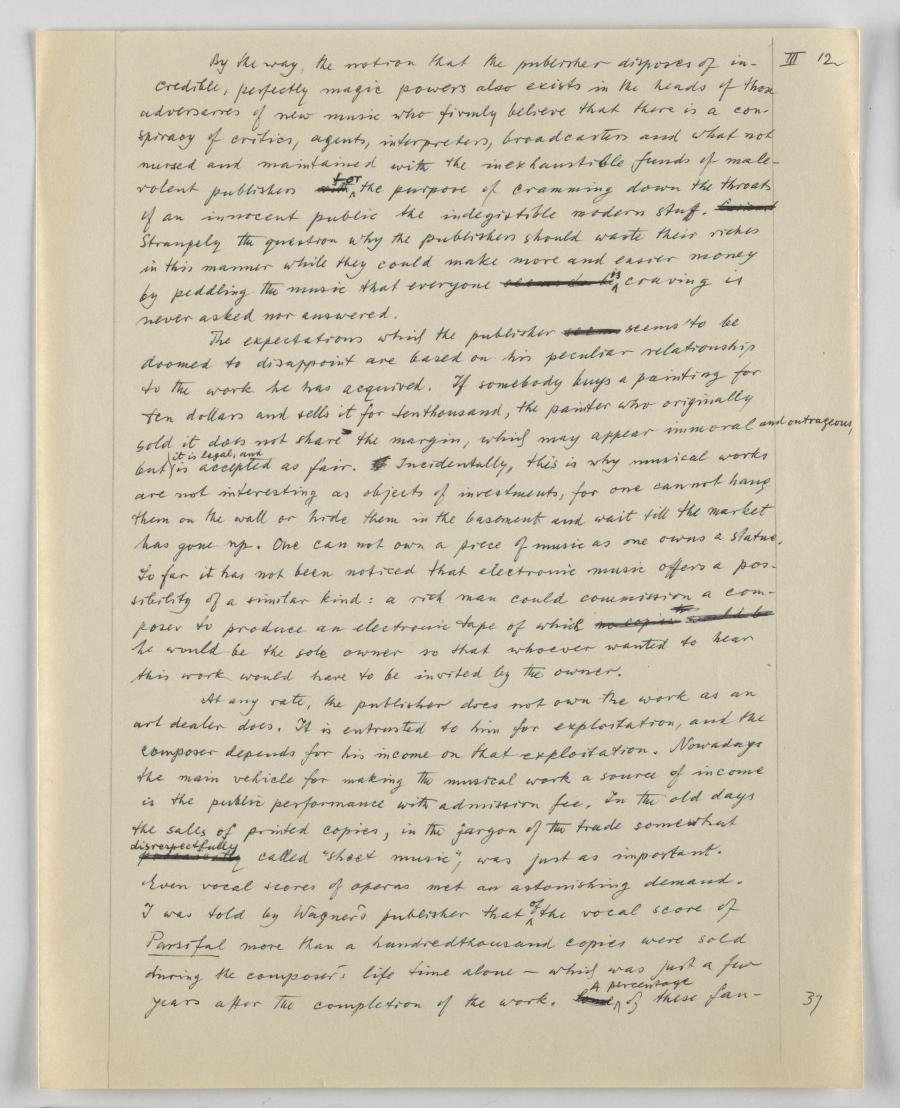
By the way, the notion that the publisher disposes of in-
credible, perfectly magic powers also exists in the heads of these
adversaries of new music who firmly believe that there is a con-
spiracy of critics, agents, interpreters, broadcasters and what not
nursed and maintained with the inexhaustible funds of male-
volent with seems be
The expectations which the publisher no copies would be
At any rate, the publisher does not own the work as an
art dealer does. It is entrusted to him for exploitation, and the
composer depends for his income on that exploitation. Nowadays
the main vehicle for making the musical work a source of income
is the public performance with admission fee. In the old days
the sales of printed copies, in the jargon of the trade somewhat
prominently Parsifal more than a hundredthousand copies were sold
during the composer's life time alone - which was just a few
years after the completion of the
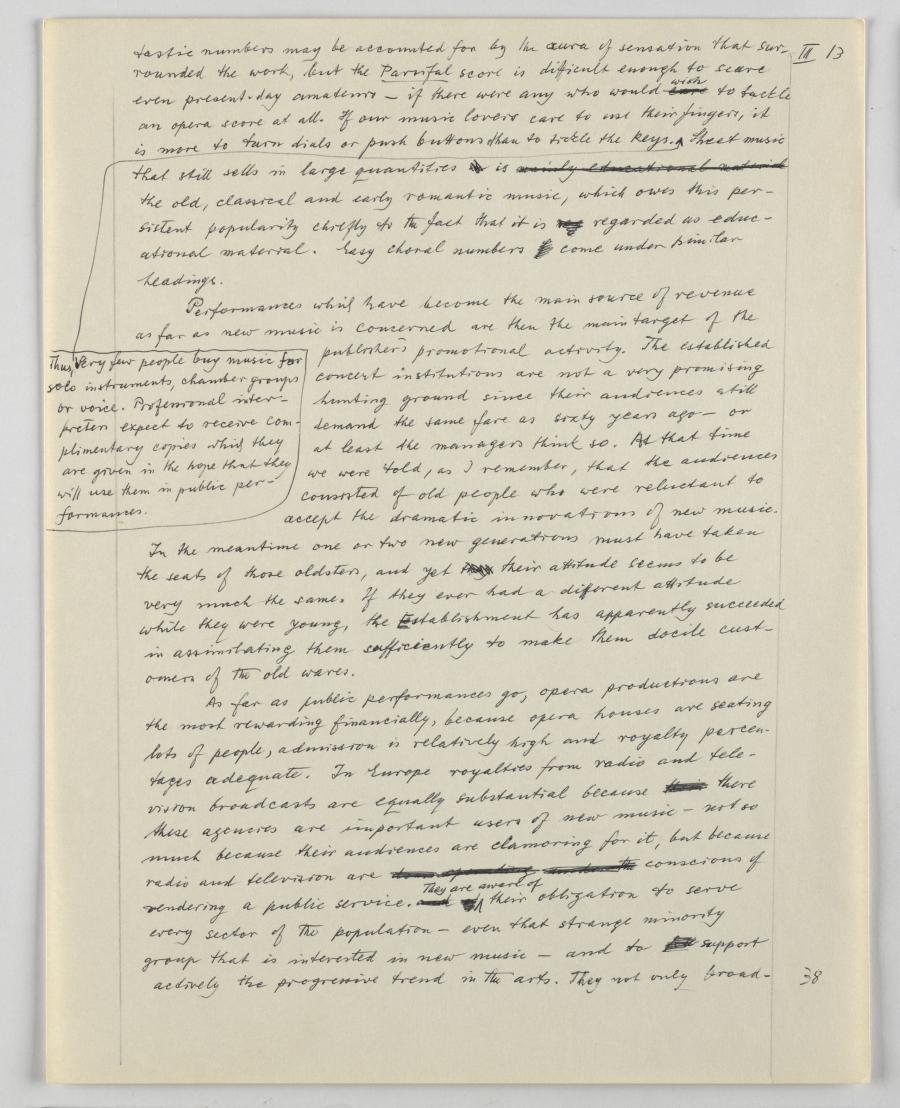
tastic numbers may be accounted for by the aura of sensation that sur-
rounded the work, but the Parsifal score is difficult enough to scare
even present-day amateurs - if there were any who
Performances which have become the main source of revenue
as far as new music is concerned are then the main target of the
publisher's promotional activity. The established
concert institutions are not a very promising
hunting ground since their audiences still
demand the same fare as sixty years ago - or
at least the managers think so. At that time
we were told, as I remember, that the audiences
consisted of old people who were reluctant to
accept the dramatic innovations of new music.
In the meantime one or two new generations must have taken
the seats of those oldsters, and yet
As far as public performances go, opera productions are
the most rewarding financially, because opera houses are seating
lots of people, admission is relatively high and royalty percen-
tages adequate. In and of
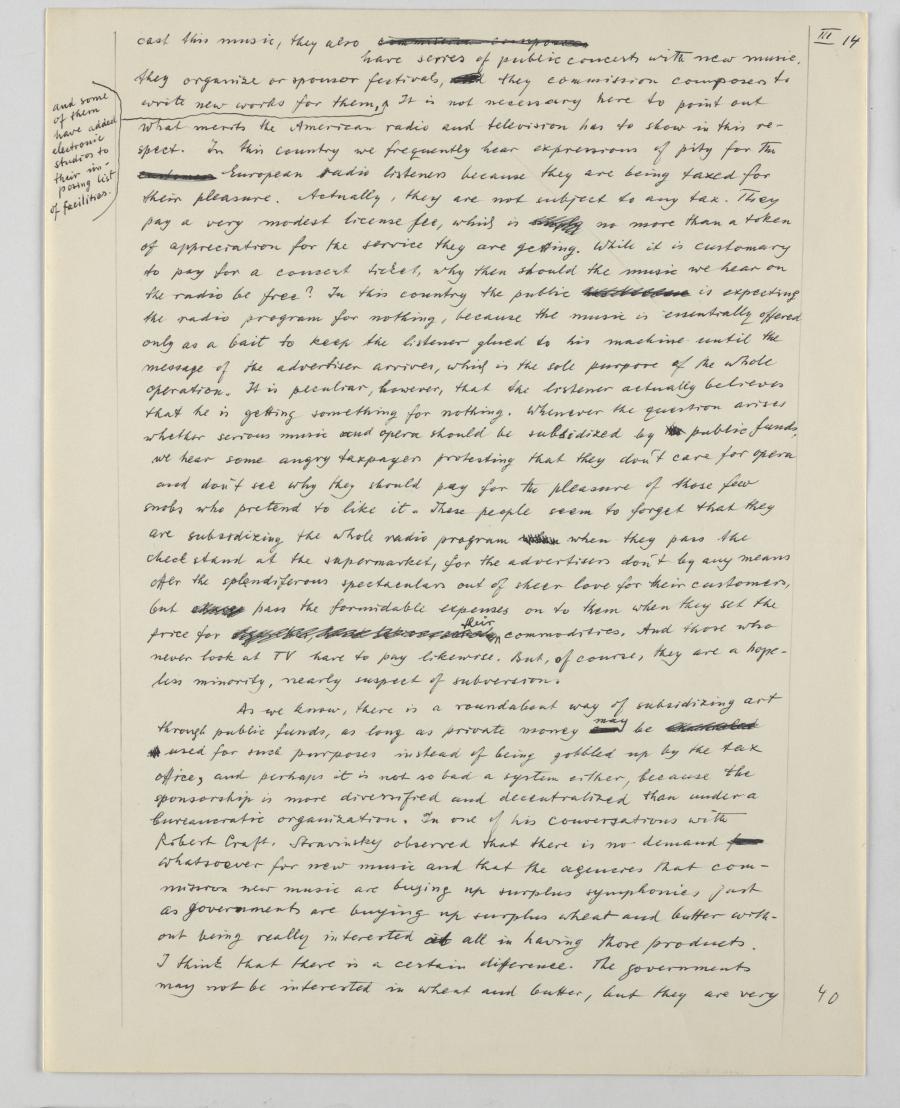
act this music, they also cigarettes, hand lotion, cereals
As we know, there is a roundabout way of subsidizing art
through public funds, as long as private can channeled
[15]
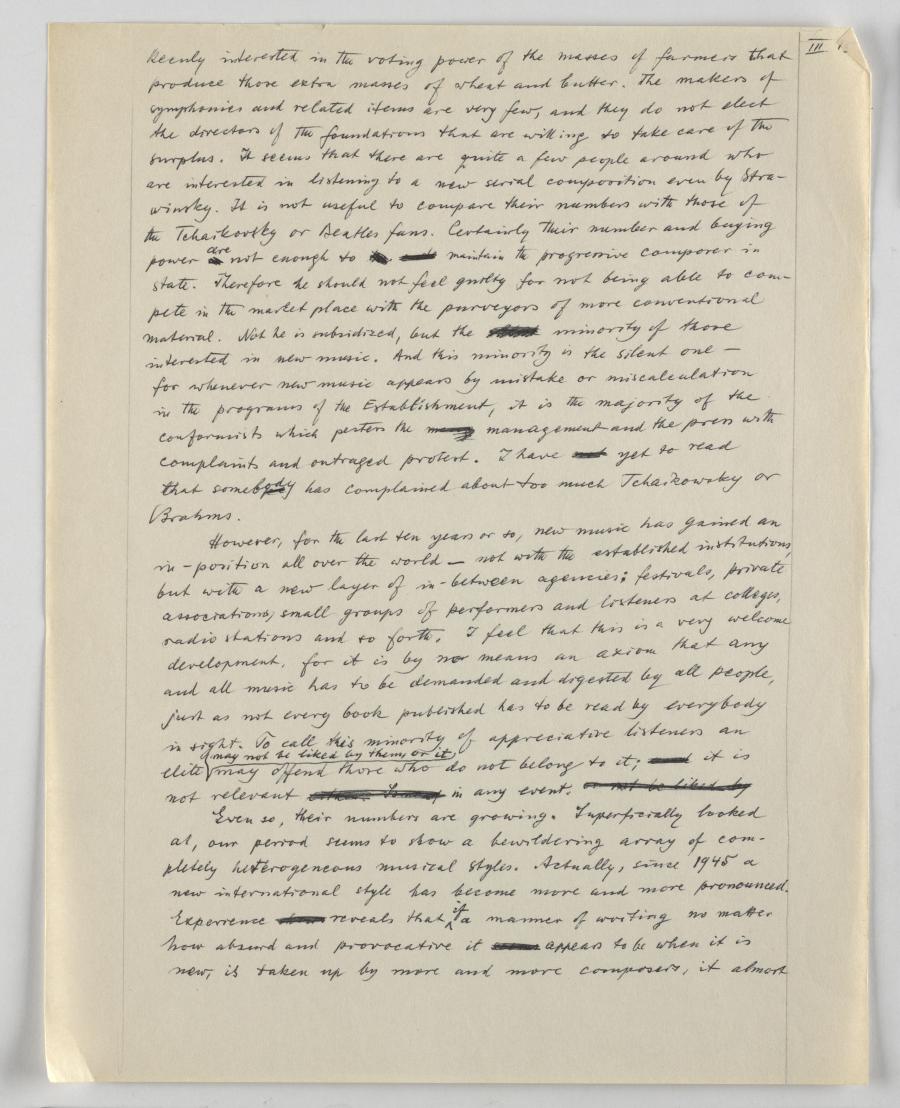
keenly interested in the voting power of the masses of farmers that
produce those extra masses of wheat and butter. The makers of
symphonies and related items are very few, and they do not elect
the directors of the foundations that are willing to take care of the
surplus. It seems that there are quite a few people around who
are interested in listening to a new serial composition even by is
Howerer, for the last ten years or so, new music has gained an
in-position all over the world - not with the established institutions
but with a new layer of in-between agencies: festivals, private
associations, small groups of performers and listeners at colleges,
radio stations and so forth. I feel that this is a very welcome
development, for it is by no means an axiom that any
and all music has to be demanded and digested by all people,
just as not every book published has to be read by everybody
in sight. To call this minority of appreciative listeners an
Even so, their numbers are growing. Superficially looked
at, our period seems to show a bewildering array of com-
pletely heterogeneous musical styles. Actually, since 1945 a
new international style has become more and more pronounced.
shows reveals that
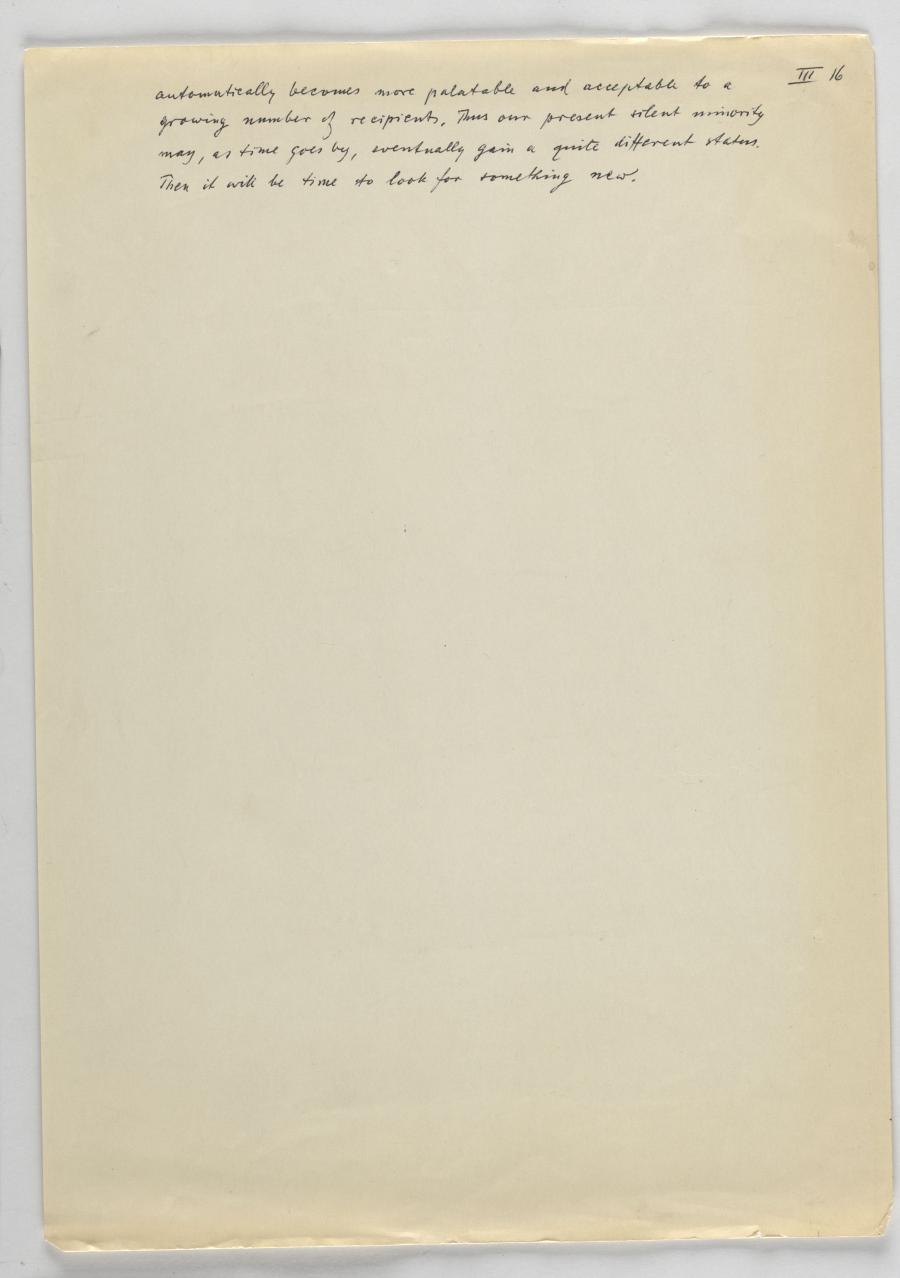
automatically becomes more palatable and acceptable to a growing number of recipients. Thus our present silent minority may, as time goes by, eventually gain a quite different status. Then it will be time to look for something new.
