Serial music today
Abstract
Am Shakespearean Festival in Stratford (Ontario, Canada) präsentierte 1960 Ernst Krenek eine theoretische Auseinandersetzung mit Fragen zu Inspiration und zu Unvorhersehbarkeit musikalischer Ereignisse in Bezug auf die Neueste Musik. Seine kursorische Darstellung einer historischen Entwicklung bis zu den jüngsten kompositorischen Konzepten wie Serialismus, Aleatorik und Elektronische Musik führt er entlang von Überlegungen zur musikalischen Zeit, zu den Relationen von Intervallen und metrischen Einheiten.
Ernst Krenek
Two years ago I caused some raised eyebrows when, in a lecture, I stated that in turning to serialism the composer has liberated himself from the dictator- ship of inspiration. People who almost religiously believe inspiration to be the only legitimate source of artistic creation did not like to hear it. What I meant to say was that in serial music the progress of the work does not depend so much on what comes into the composer's mind at any given moment, but on what is demanded by precise advance planning. Of course, the traditional composer too worked according to some plans, but while the purpose of such plans was the development of structures that were praised for being musically logical, the present planning aims at a structural organization whose coherence derives from the relationships established in a basic order of magnitudes, which order is known as "the series".
The difference may be focussed even more sharply. What in traditional music is described as its inherent logics is its analogy to language and the manifestations of the principle of causality governing speech. Similar to language, this music formulates ideas, that is, themes that become subjects of progressive variation and development, just as the linguistic statements are exposed to varying interpretation in the course of discussion, until a final state of affairs is reached that in some way or other is felt to be the necessary result of the preceding processes. In this respect older music is identified with the concept of non-reversibility, which usually is regarded to be an essential property of time.
Traditional music runs in the same direction as time does, but it also sets
itself off from time by creating its own metric configurations that seem to float
on the stream of real time. The manifestation of this peculiar musical time is
the tempo of music. The tempo is defined by how much or how little real time
elapses between the pulses of music, that is, between its accented beats. In this
way music creates the illusion that it might be able to influence the course of
time by accelerating or retarding it. This concept of tempo, materialized in more
or less regular alternation of accented and unaccented beats, has become so
integrate ingrained with us that music in which this concept recedes in the back-
ground or is totally absent appears to resist our perception. To a great extent
this is the case with mediaeval religious music. If we are to believe the monks
of Solesmes that the individual tones of the Plain Chant were, as a matter of
principle, of equal length, this condition alone certainly does not promote the
emergence of the modern concept of tempo. But even when with the ascent of poly-
phony the acceptance of the rhythmic modi of poetry established a discriminatory
measurement of long and short elements, the tempe of the music seems to have been
regarded as an immutable constant. Deviations from the standard speed were
expressed in terms of proportions, that is, prescriptions stating how many notes
of a certain category under the new speed would take up the time needed for a
different number of notes of the same category under the old speed. It is well
known that this manner of thinking led to hair-raising complications, which are by
no means less alarming than some of the exploits of present serialism. In fact, it
is not difficult to show that some of these modern complexities may well be traced
to similar psychological sources, that is, to a propensity for conceiving processes
simultaneously moving on at different speeds.
The notion that music has one direction is expressed in the tenets of the system of fuctional harmony. We remember how our harmony exercises were scrutinized by the schoolmasters for "wrong progressions." The term progression" as such indicates the concept of music's moving in one direction, from point to point, from beginning to end. Correct progressions were "logical", wrong progressions produced nonsense, just as in speech. When atonality replaced functional harmony by the much less definite, much more flexible principle of controlling the degrees of tension existing between simultaneously sounding tones, the one-way progress of music became less convincing. The twelve-tone technique has re-introduced to musical thinking the notion of the retrograde form, with implications at first perhaps not fully appreciated, - a notion that had been practicaaly dormant since the late Gothic polyphony. Even then Schoenberg used the retrograde forms of the row mainly as a welcome addition to, and variation of, the roster of basic sets. Only Webern began to create truly reversible models that may be, and are being, played in either direction.
Some years ago an atrocity story was passed around to the effect that some- where a nasty person had taken the trouble of recording some atonal composition backwards, and how he put the experts to shame when he played the record for them and they did not notice the trick, but praised the wonderful new piece. The villain of course wanted to prove that this music did not make any sense even if played in the direction planned by the composer, if one could turn it around without noting any difference. In the light of recent developments the experts would not have to blush. Just as it is obviously possible to appreciate an abstract painting from
2.
whichever angle one looks at it because the notions "right", "left, "top" and
"bottom" are not
Consciousness of the direction of music is further corroded by the atomization of time that is a consequence of subjecting the element of time to measurements derived from the basic order of magnitudes, that is, to serial organization. If the durations of tones and sounds are determined by serial definition instead of resulting from the impulses of inspiration conditioned by psychological or traditional factors, by association, description, illustration, symbolism and such, the measurements thus arrived at will not only be so-to-speak abstract, but also of high complexity. Consequently the notion of tempo as a perceptible measure of pace will not be applicable to this type of music. Here again the demand for new modes of perception arises from the very nature of serial music.
A great variety of operations is available for the predetermination of time values. So far the basic order of magnitudes, that is, the series to be regarded as the fountainhead of the entire construction, has been usually derived from certain measurable aspects of the tone row, such tone row usually containing twelve tones, as long as the music under consideration is meant to be performed on traditional instruments, or any chosen number of pitches, whenever electronic sound production is contemplated. Deriving the necessary sets of magnitudes from certain aspects of tone rows is desirable as long as one accepts as the primeval and indispensable motivation of serialism - so to speak, its ethics - the idea that all phenomena of the work ought to be traceable to one unique perceivable source. This, however, is not a necessary assumption. It is possible to visualize a totally abstract numerical series which will not only determine all other aspects of the music, but also the selection of pitches, or the tone row to be used.
If we start with the tone row, as has usually been done so far, its most obvious measurable quantities are the intervals formed by the successive pitches. Two methods of measuring them are available, as is well known: the sizes of the intervals may be expressed in terms of fractions that represent the ratios of the cycles, or they may be expressed in terms of some linear unit, such as half-tones, sixth-tones, thirteenth-tones, cents, or any other such unit of measurement. It seems to me either necessary to investigate which of the two methods sticks closer to the nature of the musical material, nor convincing to claim that one of them
3.does, as has been maintained by a few serial composers. I have always felt that, whatever the so-called natural sources of music may have been, it has traveled a long way to reach a status in which the bahavior of its particles can not any longer be referred to alleged primordial conditions.
To some of the serialists who are inclined to believe that their inventions
are so startling as to usher in a new era without precedent it may come as a surprise
that the idea of using ratios of intervals for determining time relationships is
clearly expressed by Proportionale Musices about 1475, as
may be seen in the excellent new translation by
Journal of Music
Theory. Discussing the proportions
dupla,
sesquialtera,
sesquitertia, and
sesqui-
octava, which involve time relationships of 2 : 1, 3 : 2, 4 : 3 and 9 : 8 respective- ly,
Be that as it may, the application of interval ratios to time relations is
an arbitrary process. It is true that vibration ratios are a al
Inasmuch as the numerical values established in the basic series detach themselves from the objects whose magnitudes they originally measured, as for instance the magnitudes of intervals, they become abstract operators. And inas-
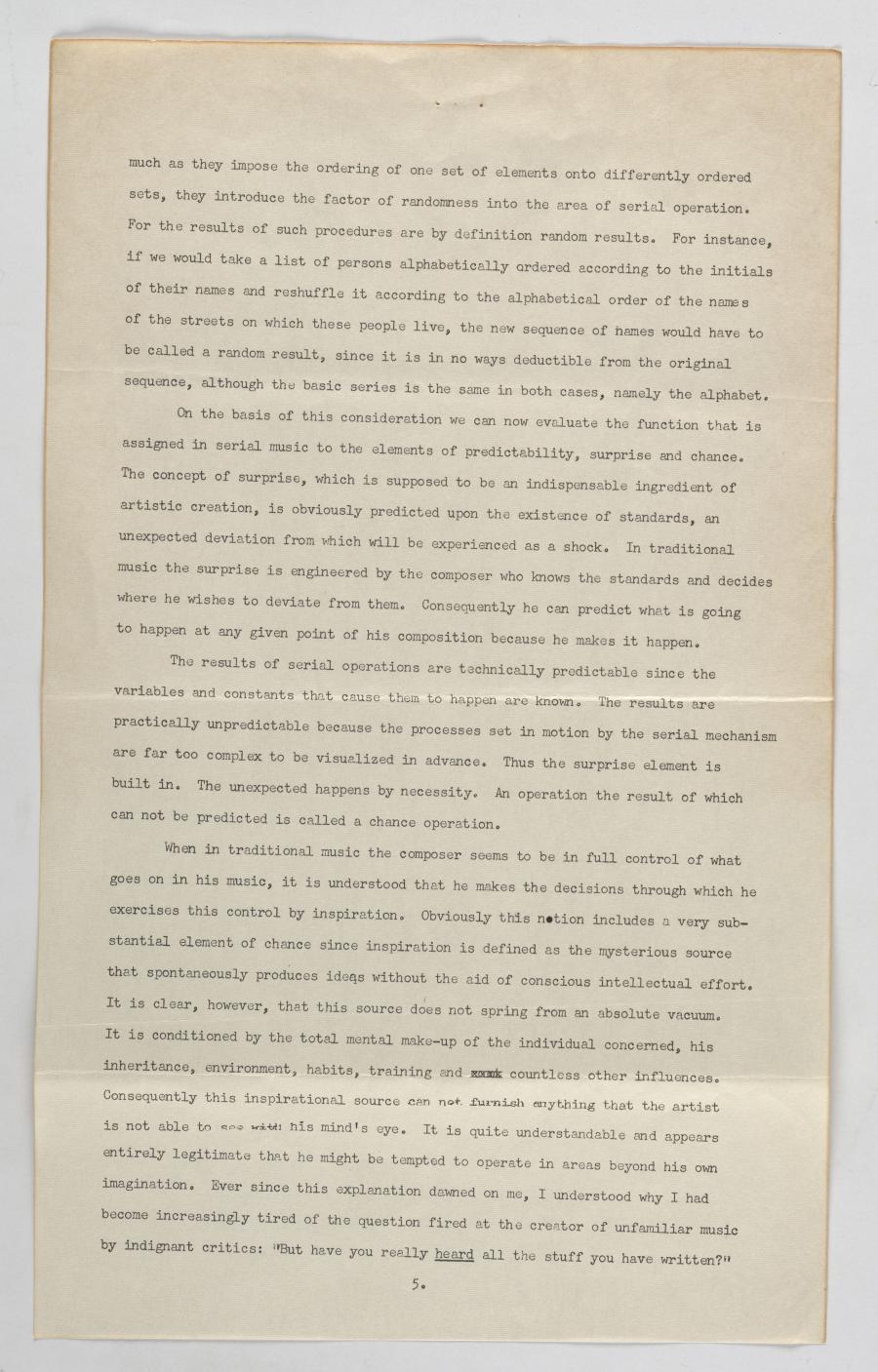
4.much as they impose the ordering of one set of elements onto differently ordered sets, they introduce the factor of randomness into the area of serial operation. For the results of such procedures are by definition random results. For instance, if we would take a list of persons alphabetically ordered according to the initials of their names and reshuffle it according to the alphabetical order of the names of the streets on which these people live, the new sequence of names would have to be called a random result, since it is in no ways deducible from the original sequence, although the basic series is the same in both cases, namely the alphabet.
On the basis of this consideration we can now evaluate the function that is assigned in serial music to the elements of predictability, surprise and chance. The concept of surprise, which is supposed to be an indispensable ingredient of artistic creation, is obviously predicted upon the existence of standards, an unexpected deviation from which will be experienced as a shock. In traditional music the surprise is engineered by the composer who knows the standards and decides where he wishes to deviate from them. Consequently he can predict what is going to happen at any given point of his composition because he makes it happen.
The results of serial operations are technically predictable since the variables and constants that cause them to happen are known. The results are practically unpredictable because the processes set in motion by the serial mechanism are far too complex to be visualized in advance. Thus the surprise element is built in. The unexpected happens by necessity. An operation the result of which can not be predicted is called a chance operation.
When in traditional music the composer seems to be in full control of what
goes on in his music, it is understood that he makes the decisions through which he
exercises this control by inspiration. Obviously this notion includes a very sub-
stantial element of chance since inspiration is defined as the mysterious source
that spontaneously produces ideas without the aid of conscious intellectual effort.
It is clear, however, that this source does not spring from an absolute vacuum.
It is conditioned by the total mental make-up of the individual concerned, his
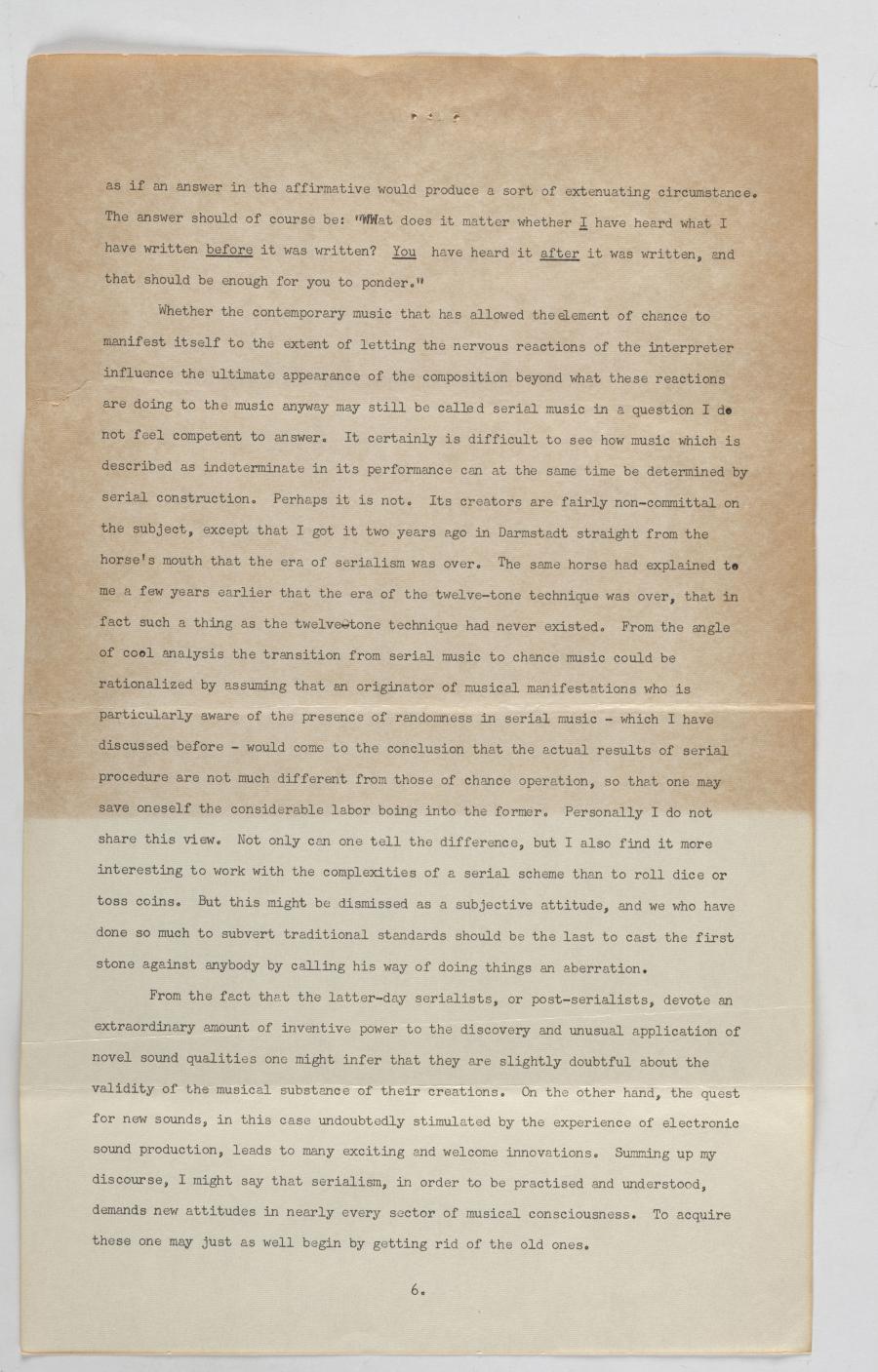
inheritance, environment, habits, training and heard all the stuff you have written?"
as if an answer in the affirmative would produce a sort of extenuating circumstance.
The answer should of course be: "WWat does it matter whether I have heard what I
have written before it was written? You have heard it after it was written, and
that should be enough for you to ponder."
Whether the contemporary music that has allowed the element of chance to
manifest itself to the extent of letting the nervous reactions of the interpreter
influence the ultimate appearance of the composition beyond what these reactions
are doing to the music anyway may still be called serial music in a question I do
not feel competent to answer. It certainly is difficult to see how music which is
described as indeterminate in its performance can at the same time be determined by
serial construction. Perhaps it is not. Its creators are fairly non-committal on
the subject, except that I got it two years ago in Darmstadt straight from the
horses mouth that the era of serialism was over. The same horse had explained to
me a few years earlier that the era of the twelve-tone technique was over, that in
fact such a thing as the
From the fact that the latter-day serialists, or post-serialists, devote an extraordinary amount of inventive power to the discovery and unusual application of novel sound qualities one might infer that they are slightly doubtful about the validity of the musical substance of their creations. On the other hand, the quest for new sounds, in this case undoubtedly stimulated by the experience of electronic sound production, leads to many exciting and welcome innovations. Summing up my discourse, I might say that serialism, in order to be practised and understood, demands new attitudes in nearly every sector of musical consciousness. To acquire these one may just as well begin by getting rid of the old ones.
6.