Lecture Boston University, fall 1938 "The Viennese School"
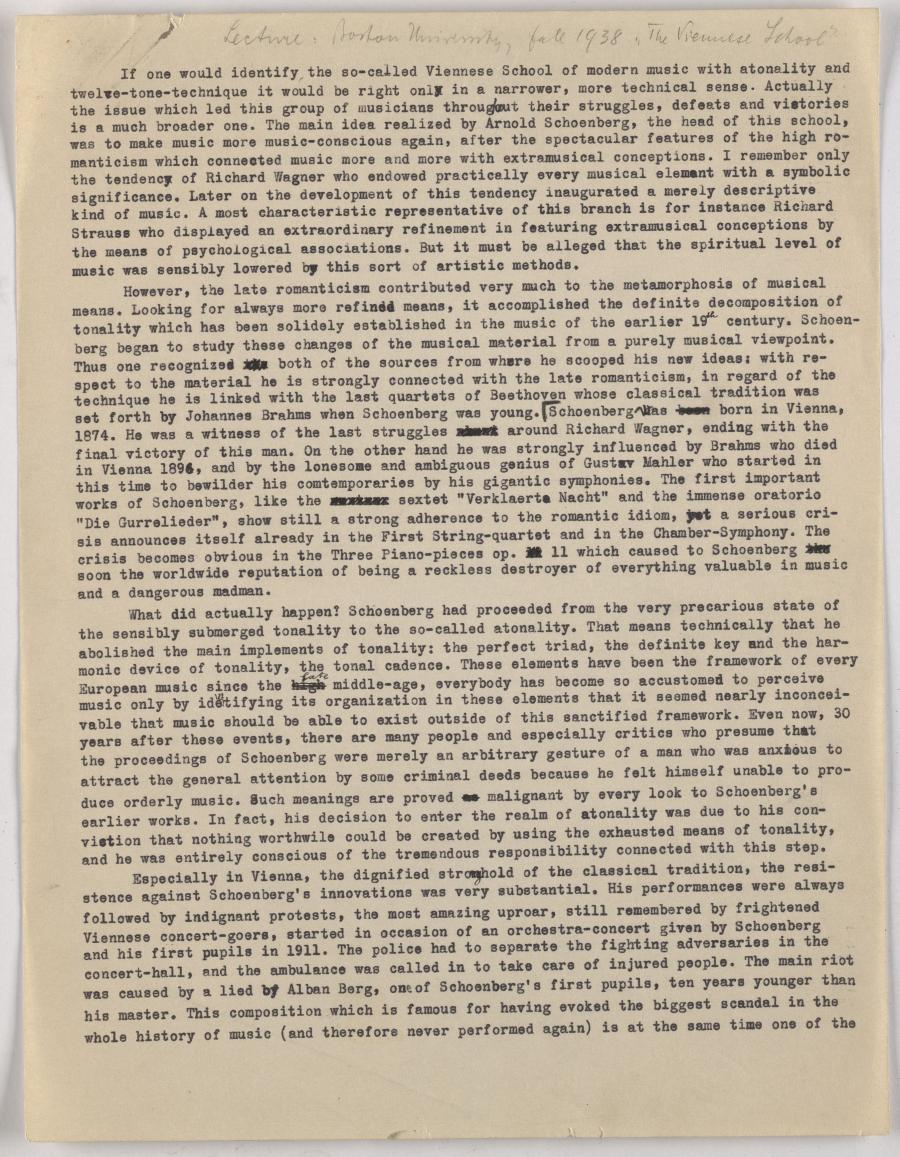
If one would identify the so called Viennese School of modern music with atonality and
twelve-tone technique it would be right only in a narrower, more technical sense. Actually
the issue which led this group of musicians through out their struggles, defeats and victories
is a much broader one. The main idea realized by Arnold Schoenberg, the head of this school,
was to make music more music-conscious again, after the spectacular features of the high ro-
manticism which connected music more and more with extramusical conceptions. I remember only
the tendency of Richard Wagner who endowed practically every musical element with a symbolic
significance. Later on the development of this tendency inaugurated a merely descriptive
kind of music. A most characteristic representative of this branch is for instance Richard
Strauss who displayed an extraordinary refinement in featuring extramusical conceptions by
the means of psychological associations. But it must be alleged that the spiritual level of
music was sensibly lowered by this sort of artistic methods.
However, the late romanticism contributed very much to the metamorphosis of musical
means. Looking for always more refined means, it accomplished the definite decomposition of
tonality which has been solidely established in the music of the earlier 19th century. Schoen-
berg began to study these changes of the musical material from a purely musical viewpoint.
Thus one recognizes been born in Vienna,
1874. He was a witness of the last struggles the
soon the worldwide reputation of being a reckless destroyer of everything valuable in music
and a dangerous madman.
What did actually happen? Schoenberg had proceeded from the very precarious state of
the sensibly submerged tonality to the so called atonality. That means technically that he
abolished the main implements of tonality: the perfect triad, the definite key and the har-
monic device of tonality, the tonal cadence. These elements have been the framework of every
European music since the high late middle-age, everybody has become so accustomed to perceive
music only by identifying its organization in these elements that it seemed nearly inconcei-
vable that music should be able to exist outside of this sanctified framework. Even now, 30
years after these events, there are many people and especially critics who presume that
the proceedings of Schoenberg were merely an arbitrary gesture of a man who was anxious to
attract the general attention by some criminal deeds because he felt himself unable to pro-
duce orderly music. Such meanings are proved
Especially in Vienna, the dignified stronghold of the classical tradition, the resi-
stence against Schoenberg's innovations was very substantial. His performances were always
followed by indignant protests, the most amazing uproar, still remembered by frightened
Viennese concert goers, started in occasion of an orchestra-concert given by Schoenberg
and his first pupils in 1911. The police had to separate the fighting adversaries in the
concert-hall, and the ambulance was called in to take care of injured people. The main riot
was caused by a lied by Alban Berg, one of Schoenberg's first pupils, ten years younger than
his master. This composition which is famous for having evoked the biggest scandal in the
whole history of music (and therefore never performed again) is at the same time one of the
- 2 -
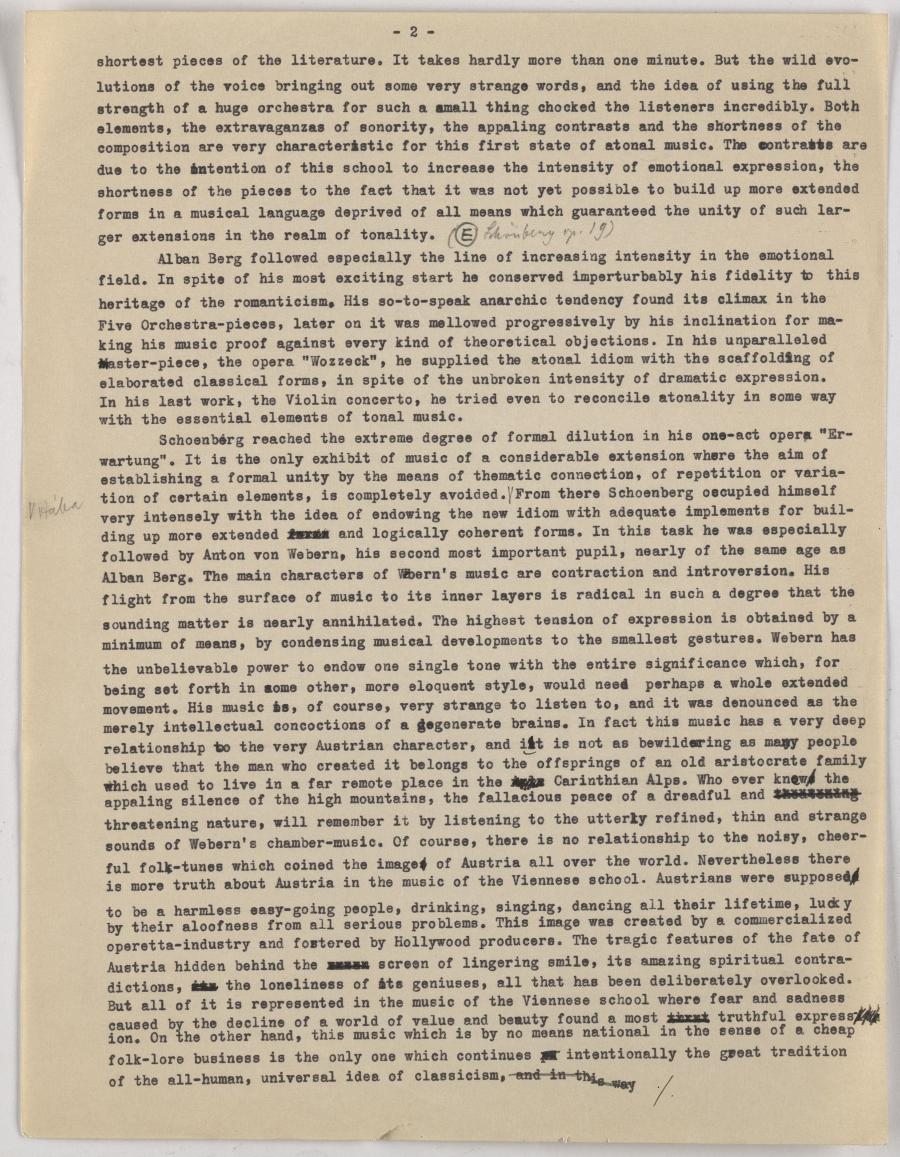
shortest pieces of the literature. It takes hardly more than one minute. But the wild evo-
lutions of the voice bringing out some very strange words, and the idea of using the full
strength of a huge orchestra for such a small thing chocked the listeners incredibly. Both
elements, the extravaganzas of sonority, the appaling contrasts and the shortness of the
composition are very characteristic for this first state of atonal music. The contracts are
due to the intention of this school to increase the intensity of emotional expression, the
shortness of the pieces to the fact that it was not yet possible to build up more extended
forms in a musical language deprived of all means which guaranteed the unity of such lar-
ger extensions in the realm of tonality. (2) Sie
(E Schönberg op. 19)
Alban Berg followed especially the line of increasing intensity in the emotional
field. In spite of his most exciting start he conserved imperturbably his fidelity to this
heritage of the romanticism. His so-to-speak anarchic tendency found its climax in the
Five Orchestra-pieces, later on it was mellowed progressively by his inclination for ma-
king his music proof against every kind of theoretical objections. In his unparalleled
Master piece, the opera "Wozzeck", he supplied the atonal idiom with the scaffolding of
elaborated classical forms, in spite of the unbroken intensity of dramatic expression.
In his last work, the Violin concerto, he tried even to reconcile atonality in some way
with the essential elements of tonal music.
Schoenberg reached the extreme degree of formal dilution in his one-act opera "Er-
wartung". It is the only exhibit of music of a considerable extension where the aim of
establishing a formal unity by the means of thematic connection, of repetition or varia-
tion of certain elements, is completely avoided. From there Schoenberg occupied himself
very intensely with the idea of endowing the new idiom with adequate implements for buil-
ding up more extended s the
appaling silence of the high mountains, the fallacious peace of a dreadful and d
to be a harmless easy-going people, drinking, singing, dancing all their lifetime, lucky
by their aloofness from all serious problems. This image was created by a commercialized
operetta-industry and fostered by Hollywood producers. The tragic features of the fate of
Austria hidden behind the its the loneliness of its geniuses, all that has been deliberately overlooked.
But all of it is represented in the music of the Viennese school where fear and sadness
caused by the decline of a world of value and beauty found a most and in this way
Hába
- 3 -
it is full of promises for a happier future of mankind.
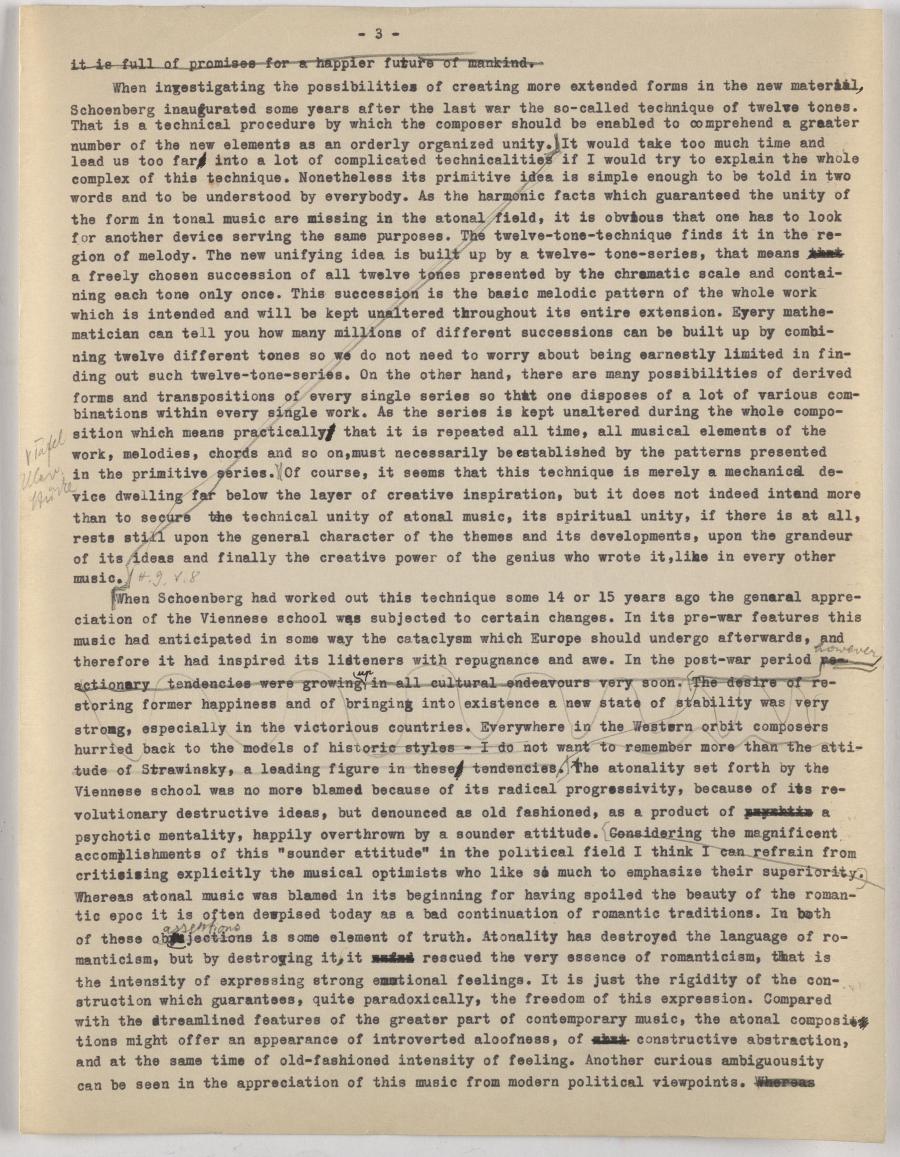
When investigating the possibilities of creating more extended forms in the new material
Schoenberg inaugurated some years after the last war the so-called technique of twelve tones.
That is a technical procedure by which the composer should be enabled to comprehend a greater
number of the new elements as an orderly organized unity. It would take too much time and
lead us too fars into a lot of complicated technicalities if I would try to explain the whole
complex of this technique. Nonetheless its primitive idea is simple enough to be told in two
words and to be understood by everybody. As the harmonic facts which guaranteed the unity of
the form in tonal music are missing in the atonal field, it is obvious that one has to look
for another device serving the same purposes. The twelve tone technique finds it in the re-
gion of melody. The new unifying idea is built up by a twelve tone series, that means that
a freely chosen succession of all twelve tones presented by the chromatic scale and contai-
ning each tone only once. This succession is the basic melodic pattern of the whole work
which is intended and will be kept unaltered throughout its entire extension. Every mathe-
matician can tell you how many millions of different successions can be built up by combi-
ning twelve different tones so we do not need to worry about being earnestly limited in fin-
ding out such twelve-tone series. On the other hand, there are many possibilities of derived
forms and transpositions of every single series so that one disposes of a lot of various com-
binations within every single work. As the series is kept unaltered during the whole compo-
sition which means practicallyy that it is repeated all time, all musical elements of the
work, melodies, chords and so on, must necessarily be established by the patterns presented
in the primitive séries. Of course, it seems that this technique is merely a mechanical de-
vice dwelling far below the layer of creative inspiration, but it does not indeed intend more
than to secure the technical unity of atonal music, its spiritual unity, if there is at all,
rests still upon the general character of the themes and its developments, upon the grandeur
of its ideas and finally the creative power of the genius who wrote it, like in every other
music. H.9. S.8
Tafel
Klav.
Stücke
When Schoenberg had worked out this technique some 14 or 15 years ago the general appre-
ciation of the Viennese school was subjected to certain changes. In its pre-war features this
music had anticipated in some way the cataclysm which Europe should undergo afterwards, and
therefore it had inspired its listeners with repugnance and awe. In the post-war period however re-
actionary tendencies were growing up in all cultural endeavours very soon. The desire of re-
storing former happiness and of bringing into existence a new state of stability was very
strong, especially in the victorious countries. Everywhere in the Western orbit composers
hurried back to the models of historic styles - I do not want to remember more than the atti¬
tude of Strawinsky, a leading figure in these tendencies. The atonality set forth by the
Viennese school was no more blamed because of its radical progressivity, because of its re-
volutionary destructive ideas, but denounced as old fashioned, as a product of Considering the magnificent
accomplishments of this "sounder attitude" in the political field I think I can refrain from
criticising explicitly the musical optimists who like so much to emphasize their superiority.
Whereas atonal music was blamed in its beginning for having spoiled the beauty of the roman-
tic epoc it is often despised today as a bad continuation of romantic traditions. In both
of these objections assentions is some element of truth. Atonality has destroyed the language of ro-
manticism, but by destroying it, it Whereas
- 4 -
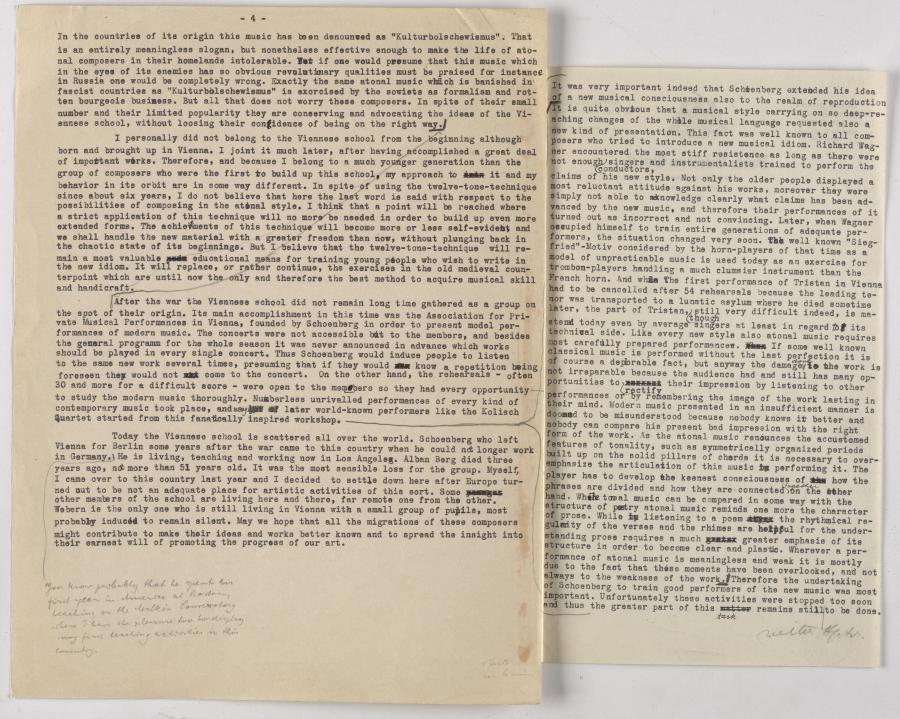
In the countries of its origin this music has been denounced as "Kulturbolschewismus". That
is an entirely meaningless slogan, but nonetheless effective enough to make the life of ato-
nal composers in their homelands intolerable. Yet if one would presume that this music which
in the eyes of its enemies has so obvious revolutionary qualities must be praised for instance
in Russia one would be completely wrong. Exactly the same atonal music which is banished in
fascist countries as "Kulturbolschewismus" is exorcised by the sowiets as formalism and rot-
ten bourgeois business. But all that does not worry these composers. In spite of their small
number and their limited popularity they are conserving and advocating the ideas of the Vi-
ennese school, without loosing their confidence of being on the right way.
I personally did not belong to the Viennese school from the beginning although
born and brought up in Vienna. I joint it much later, after having accomplished a great deal
of important works. Therefore, and because I belong to a much younger generation than the
group of composers who were the first to build up this school, my approach to it and my
behavior in its orbit are in some way different. In spite of using the twelve-tone-technique
since about six years, I do not believe that here the last word is said with respect to the
possibilities of composing in the atonal style. I think that a point will be reached where
a strict application of this technique will no more be needed in order to build up even more
extended forms. The achievements of this technique will become more or less self-evident and
we shall handle the new material with a greater freedom than now, without plunging back in
the chaotic state of its beginnings. But I believe that the twelve-tone-technique will re-
main a most valuable educational means for training young people who wish to write in
the new idiom. It will replace, or rather continue, the exercises in the old medieval count-
terpoint which are until now the only and therefore the best method to acquire musical skill
and handicraft.
After the war the Viennese school did not remain long time gathered as a group on
the spot of their origin. Its main accomplishment in this time was the Association for Pri-
vate Musical Performances in Vienna, founded by Schoenberg in order to present model per-
formances of modern music. The concerts were not accessible but to the members, and besides
the general programm for the whole season it was never announced in advance which works
should be played in every single concert. Thus Schoenberg would induce people to listen
to the same new work several times, presuming that if they would know a repetition being
foreseen they would not not come to the concert. On the other hand, the rehearsals - often
30 and more for a difficult score - were open to the memlot of later world-known performers like the Kolisch
Quartet started from this fanatically inspired workshop.
It was very important indeed that Schoenberg extended his idea
of a new musical consciousness also to the realm of reproduction
(It is quite obvious that a musical style carrying on so deep-re-
aching changes of the whole musical language requested also a
new kind of presentation. This fact was well known to all com-
posers who tried to introduce a new musical idiom. Richard Wag
ner encountered the most stiff resistence as long as there were
not enough conductors, singers and instrumentalists trained to perform the
claims of his new style. Not only the older people displayed a
most reluctant attitude against his works, moreover they were
simply not able to aknowledge clearly what claims has been ad-
vanced by the new music, and therefore their performances of it
turned out as incorrect and not convincing. Later, when Wagner
occupied himself to train entire generations of adequate per-
formers, the situation changed very soon. well known "Sieg-
fried"-Motiv considered by the horn-players of that time as a
model of unpracticable music is used today as an exercise for
trombon-players handling a much clumsier instrument than the
French horn. And while the first performance of Tristan in Vienna
had to be cancelled after 54 rehearsals because the leading te-
nor was transported to a lunatic asylum where he died sometime
later, the part of Tristan, though still very difficult indeed, is ma-
stered today even by average singers at least in regard to grater greater emphasis of its
structure in order to become clear and plastic. Wherever a per-
formance of atonal music is meaningless and weak it is mostly
due to the fact that these moments have been overlooked, and not
always to the weakness of the work. Therefore the undertaking
of Schoenberg to train good performers of the new music was most
important. Unfortunately these activities were stopped too soon
and thus the greater part of this matter task remains still to be done.
weiter Hptr.
Today the Viennese school is scattered all over the world. Schoenberg who left
Vienna for Berlin some years after the war came to this country when he could not longer work
in Germany. He is living, teaching and working now in Los Angeles. Alban Berg died three
years ago, not more than 51 years old. It was the most sensible loss for the group. Myself,
I came over to this country last year and I decided to settle down here after Europe tur-
ned out to be not an adequate place for artistic activities of this sort. Some younger
other members of the school are living here and there, far remote one from the other.
Webern is the only one who is still living in Vienna with a small group of pupils, most
probably induced to remain silent. May we hope that all the migrations of these composers
might contribute to make their ideas and works better known and to spread the insight into
their earnest will of promoting the progress of our art.
You know probably that he spent his
first year in America at Boston,
teaching on the Malkin Conservatory
where I have the pleasure too to display
my first teaching activities in this
country.
1 Seite
ca. 6 min